

Die-Cut or Laser-Cut Printing: How to Choose for Packaging, Labels and Event Materials
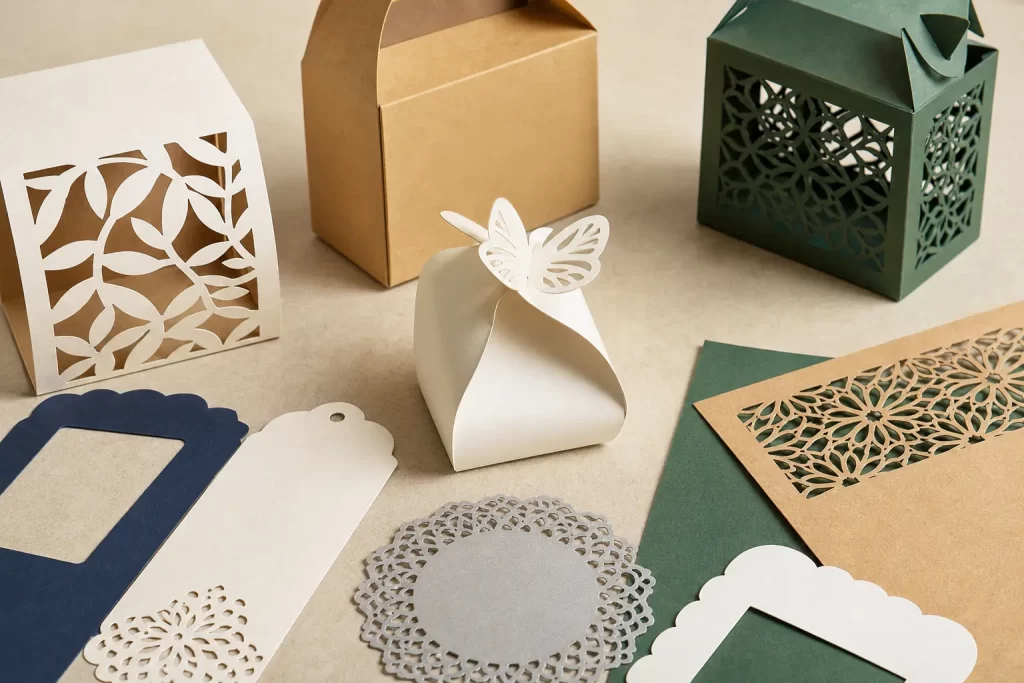
Choose die-cut when you need high-volume, consistent die profiles, tight registration and complex multi-up shapes suitable for steel-rule dies and mass production; choose laser-cut when you need rapid prototyping, short runs, fine intricate details, variable or on-demand cutting without die tooling.
What is die-cutting?
Die-cutting is a finishing process that uses a physical die to stamp or cut repeated shapes from paperboard, labels, sleeves and cartons for consistent, high-volume production.
Die-cutting typically uses a hardened rule or engraved plate (the die) matched to a supplied dieline to cut, kiss-cut (cut outline but not liner), or perforate sheets in repeat. Advantages of die-cutting include very consistent edge quality across long runs, fast press-side throughput once the die is mounted, and reliable registration for multi-up layouts. Practical limits include the need for a dedicated die, setup time and cost for tooling, and less flexibility for last-minute design changes.
What is laser-cutting?
Laser-cutting is a finishing process that uses a focused laser beam to cut, etch or score materials for intricate shapes, variable data cuts and short or one-off runs without physical tooling.
Laser-cutting produces fine internal details, rounded and delicate internal cuts, and fast iteration because it requires no hard die. Laser work is ideal for prototypes, bespoke event items and low-volume specialty labels. Trade-offs include slower unit throughput on large runs, potential edge discoloration or heat-affected zones on some coated stocks and limitations with heavily laminated or metallic foils.
When should I choose die-cut for packaging, labels and event materials?
Die-cut is the right choice when packaging, labels or event materials require repeated identical shapes, stable registration across many sheets and efficient production at scale.
- Choose die-cut for carton blanks, multi-up label ganging and common ticket or sleeve shapes where repeatability reduces per-piece cost.
- Choose die-cut when the job uses heavy boards, thick liners or requires secondary creasing, stripping or ejection that benefit from a physical die.
- Choose die-cut when post-press operations like embossing, foil stamping or hot-foil application must align consistently to the cut shape.
When should I choose laser-cut?
Laser-cut is the right choice when you need rapid prototyping, one-off dieless shapes, personalization or highly detailed cut patterns that would be costly or slow to tool conventionally.
- Choose laser-cut for sample runs, event invitations with fine filigree, custom place cards, or variable-cut labels where each piece may differ.
- Choose laser-cut when you want fast design changes or to test multiple shape options before committing to a die.
- Choose laser-cut for delicate internal cutouts that are difficult to strip from a die without damage.
How do material and finishing choices affect the decision?
Material and finishing choices determine whether die-cutting or laser-cutting is more suitable based on stock type, surface finishes and secondary processes.
- Paperboard and most uncoated or lightly coated stocks accept either process; heavily laminated, metallic or foil-stamped surfaces often favour die-cut to avoid heat damage.
- Adhesive-backed labels with liners generally work with die-cut for kiss-cuts; laser-cut can cut face stock but may affect liner integrity or adhesive behaviour on some constructions.
- Finishes such as hot foil, deep embossing or mechanical creasing typically require a die-based workflow to control registration and pressure.
What are the production and cost trade-offs?
Production and cost trade-offs depend on tooling cost, run length and complexity: die-cut requires upfront tooling cost but lowers per-piece cost on longer runs, while laser-cut removes tooling cost but can be slower and more costly per unit for high volumes.
- Consider tooling: die dies add one-time cost and setup time but amortise across larger runs; laser-cut avoids tooling and suits iterative design or short runs.
- Consider throughput: die-cutting runs faster on press and finishing lines for mass quantities; laser-cutting is flexible but typically better for prototypes and limited quantities.
- Consider quality and consistency: die-cutting gives stable margins and predictable ejection for heavy stocks; lasers give superior detail but may need additional finishing to hide heat-affected edges on some materials.
What checklist should I use to decide?
Use this checklist of project factors to choose between die-cut and laser-cut for your print job.
- Define run length: choose die-cut for repeat long runs, laser-cut for short or one-off runs.
- Assess detail level: choose laser-cut for very fine internal cuts; choose die-cut for robust external cuts and heavy board support.
- Check materials and finishes: choose die-cut when using metallic foils, deep embossing or thick laminates; choose laser-cut for uncoated or lightly coated stocks needing fine detail.
- Consider design iteration: choose laser-cut to prototype shapes quickly; choose die-cut when final dielines are confirmed.
- Plan registration: choose die-cut for tight registration across multi-up sheets or combined finishing operations.
How does PrintPlus support die-cut and laser-cut projects?
PrintPlus supports both die-cut and laser-cut finishing as part of its commercial print finishing options and can advise on dielines, file preparation and quality checks for production.
PrintPlus offers design support and file-fixing, coordinates finishing workflows and inspects production quality to align cuts with creases, foils and varnishes. Discuss intended run length, material and finishing expectations with your PrintPlus project contact so the chosen method matches design goals and production efficiency.
Summary: Choose die-cut for consistent high-volume runs, robust board work and tight registration; choose laser-cut for prototyping, fine detail and short or bespoke runs. Use the checklist above to match run length, detail level, materials and post-press finishes to the appropriate method.
Discuss your print project or request a tailored quote from PrintPlus.