

Corporate Annual Printing in Hong Kong: How to Plan a High-Quality Company Annual
Corporate Annual Printing in Hong Kong: How to Plan a High-Quality Company Annual
A corporate annual is both a regulatory document and a brand instrument. Early planning prevents costly last-minute choices, protects print quality and ensures the finished book meets governance, investor and stakeholder expectations.
1. Define scope, audience and regulatory needs
Identify how many formats you need (print, PDF, investor pack), who will receive each version, and any regulatory content that must appear (financial statements, statutory notes, auditors’ wording). Confirm which language editions are required and whether regional language variations need separate layout; Hong Kong commonly requires Traditional Chinese variants where relevant, so plan for separate layout and native proofreading where necessary. Verify any local Hong Kong statutory wording and filing requirements with your company secretary or legal adviser rather than assuming template text.
2. Editorial and content checklist
Prepare a single content master that collects approved text, tables, images and captions. Include final figures in a dedicated spreadsheet rather than embedding them in page layout files; that reduces risk of accidental edits during typesetting. Provide image assets at their native resolution and add an image inventory that notes captions and credit lines.
3. Design and layout considerations for print
Control typographic hierarchy, paragraph styles and table formatting centrally. Use consistent margins and a baseline grid to keep columns aligned across sections. For long tables or multi-page financial statements, consider repeating column headers and including table identifiers for cross-referencing.
4. Paper and stock selection
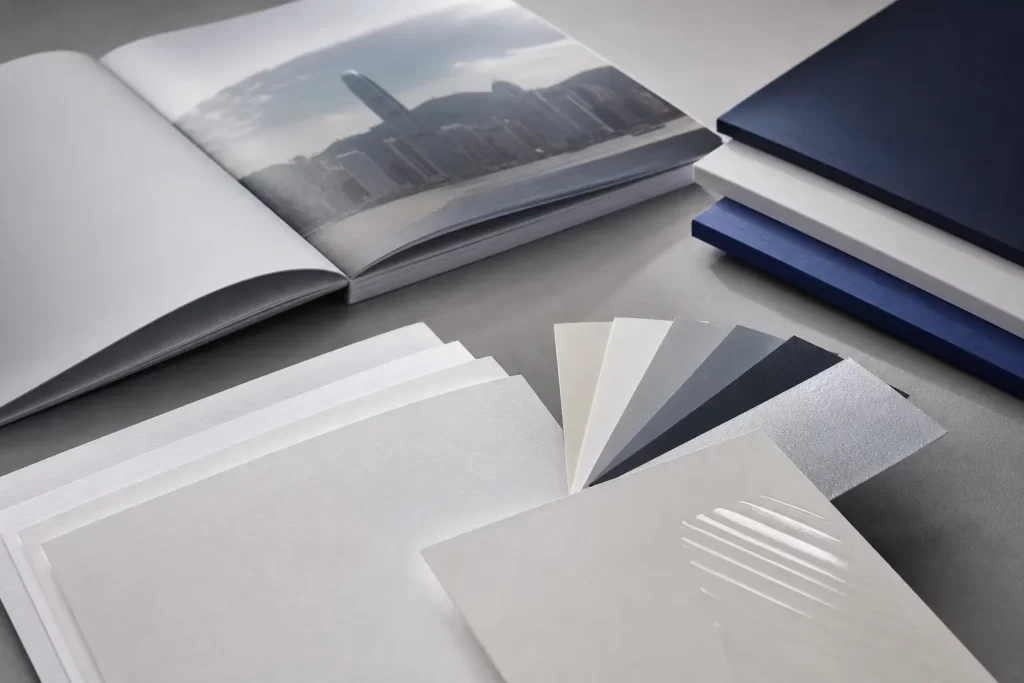
Choose separate stocks for cover and text. A heavier, coated or uncoated cover stock supports foil, embossing and sturdier binding; interior paper choices affect opacity, show-through and image reproduction. Confirm paper weight ranges and finish options with your printer early so cover sizing and spine calculations can be finalised once the page count is fixed. For technical background on paper finishes and surface options, see the guidance on paper surface and finish.
5. Printing methods: offset versus digital
Offset printing provides consistent colour across larger runs and wide substrate options. Digital printing suits smaller runs, variable content and tight proofs. Decide based on final print quantity and whether each copy must be identical or personalised. Ask the printer about colour-process control and whether spot colours or Pantone matches are required for brand elements.
6. Finishing and binding options
Common finishes for annuals include casebound (hardcover), perfect binding (softcover) and Smyth-sewn sections for durability. Decorative finishes – foil stamping, embossing, spot UV and die-cut elements – elevate presentation but add setup and handling steps. If a cover design uses heavy debossing or foil, confirm plate and tooling requirements in advance.
7. Preparing print-ready files
Supply page proofs as high-resolution PDF/X files with embedded fonts and images. Include trim, bleed and safe-area marks; maintain bleeds (typically 3-5 mm) on artwork that extends to the edge. For multi-language projects, provide separate files per edition or a clear layer structure so the printer can verify content without layout rework.
8. Colour management and proofs
Use CMYK for final print artwork and convert RGB images with a suitable colour profile; for technical context on colour models, see CMYK colour model. For critical brand colours, supply Pantone references and discuss whether spot inks are needed. Request a hard-copy proof when colour precision matters; a digital proof is useful earlier in the workflow but cannot substitute for a press or contract proof when final colour approval is required.
9. Proofing and quality checks
Plan at least two formal proofing rounds: an editorial proof for text accuracy and a production proof for layout, pagination and colour. Run a preflight check to catch missing fonts, low-resolution images or RGB objects. Verify page numbering, footnotes, cross-references and the placement of statutory wording. Keep a short defects log and resolve issues before final approval.
10. Logistics: quantities, distribution and storage
Decide whether the printer will ship finished copies to multiple addresses or deliver a single consolidated shipment. Consider warehousing if you need phased distribution. Confirm packaging that protects covers and corners during transit, and include an inventory count with each delivery.
11. Illustrative timeline (for planning only)
Illustrative scenario: for a mid-length annual (80-160 pages), allow time for content sign-off, design and layout, two proof cycles and production. Use this as a planning guide rather than a fixed schedule; final lead times will depend on page count, finishes and run size.
12. Small practical checklist before print approval
- Finalised master text and approved figures
- High-resolution images with captions and credits
- Choice of cover and text stock confirmed
- Approved proofs for editorial and production
- Delivery and packaging instructions confirmed